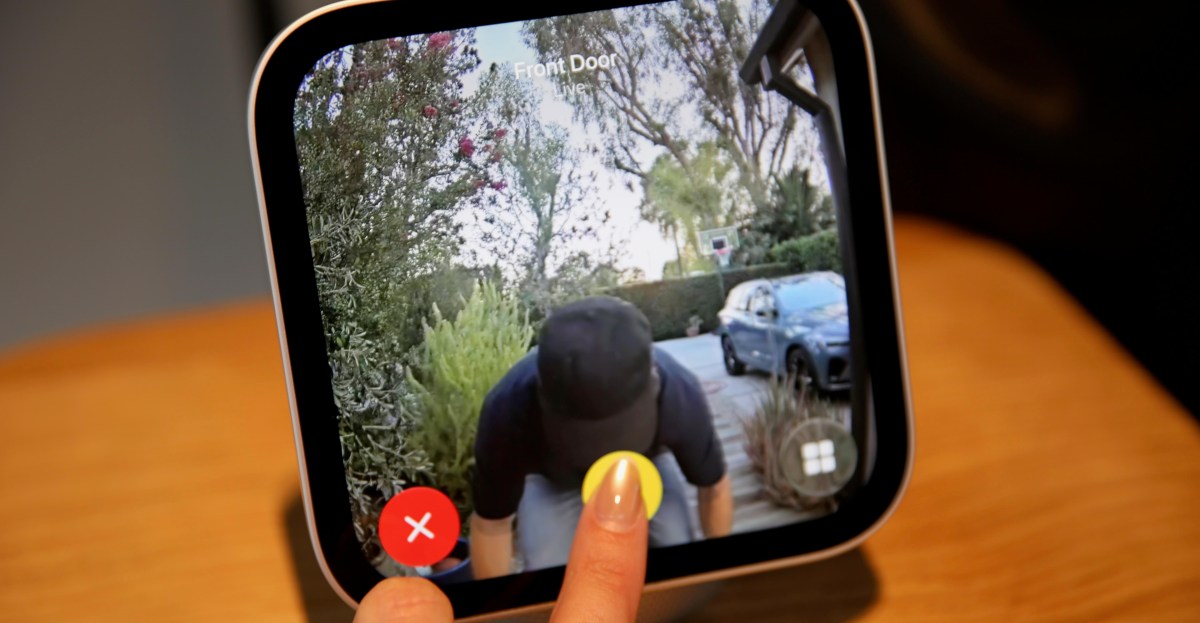
Apple HomeView May Soon Double as a HomeKit Security Camera, Hidden Code Suggests
Newly discovered code strings within Apple’s HomeView software are pointing to a significant new role for the company’s smart home hub. A Reddit user named pdfu, posting on the HomeKit subreddit, says that HomeView 27.2 contains hidden references to a “security camera mode” with motion detection, live streaming, recording options, and privacy controls. The strings reportedly include a setup page that explicitly reads: “Your HomeView can be used as a security camera with HomeKit Secure Video.”
If accurate, this would transform HomeView from a simple display for controlling smart home accessories into an active security device. The HomeView, Apple’s smart display, has been marketed as a central command center for HomeKit homes, but many users have wondered why a device with a built-in camera didn’t already offer security camera features. The new code hints may provide an answer: Apple may be preparing to activate that functionality through a future software update, with the feature set designed to meet the company’s strict privacy standards.
According to pdfu’s analysis, the code describes a mode in which the HomeView’s camera can be used as a HomeKit Secure Video camera. That integration is key. HomeKit Secure Video is Apple’s encrypted video service that allows compatible cameras to record and stream footage without giving Apple access to the content. Footage is analyzed on-device for activity, and only encrypted video is uploaded to iCloud, where it can be viewed by authorized users. If HomeView taps into this system, it would mean the smart display could serve as a fully functional security camera for people who already rely on Apple’s smart home ecosystem.
The reported privacy features are extensive. The video feeds are expected to be visible only to members of the home, meaning guests or visitors won’t be able to access the camera feed. There will also be an indicator light and an audible sound whenever someone is watching the live feed or whenever recording begins. That is an important privacy safeguard, because it ensures that anyone in the room knows the camera is active. Home members will also receive a notification any time settings are changed in the Secure Video mode, giving the household full visibility into who is modifying the camera configuration.
The code also suggests customizable detection and recording options based on the household’s status. Users may be able to choose what to detect, stream, or record depending on whether they are at home, away, or asleep. For example, when everyone is away, the HomeView might be configured to record all motion and stream live video to authorized family members. When someone is at home, the camera could be set to ignore movement or only record when a specific person or pet is detected. When the household is asleep, it could focus on unusual activity in common areas or near entry points. These granular controls would give users flexibility while maintaining privacy.
This is not the first time that Apple’s smart display has been the subject of speculation about security camera features. From the moment HomeView was announced, observers pointed out that the device’s built-in camera could easily be repurposed as a security camera. However, Apple did not include such a feature at launch. The company has never publicly explained why, but there are several plausible reasons. One possibility is that Apple wanted to avoid any perception that a smart display in the home was secretly recording. Another is that the company was waiting for its privacy and encryption systems to mature. Given Apple’s heavy emphasis on privacy in its marketing, it would be surprising if the company introduced a security camera feature without robust safeguards.
Apple’s privacy positioning has long been central to its brand. The company has run ads emphasizing that iCloud backups are encrypted, and it has promoted technologies like Private Cloud Compute, which allows AI features to process data without exposing personal information to Apple. In the smart home space, Apple has repeatedly stressed that HomeKit accessories are encrypted and that Siri voice recordings are not sold or shared. A HomeView security camera mode would need to be held to the same standard. The code’s apparent inclusion of indicator lights, sounds, and notifications suggests Apple is taking that responsibility seriously.
For users, the potential feature would be convenient. Instead of buying a separate security camera, anyone who already owns a HomeView could turn it into a HomeKit Secure Video camera with a software update. That would save money and reduce clutter. It would also mean that the camera is positioned in a location where the user chose to place the smart display, which is often in a central area like a kitchen or living room. That could be useful for monitoring pets, checking in on children, or keeping an eye on the home while away. But it also raises the question of whether a device that is designed to be visible and interactive should be used as a surveillance tool. Apple’s apparent answer is to make the camera’s status unmistakable.
The discovery has generated discussion in the HomeKit community. Some users are excited about the possibility of expanding their security system without buying new hardware. Others are cautious, noting that hidden code strings don’t always lead to actual features. Apple frequently tests new ideas internally and sometimes abandons them before release. The fact that the setup page text exists in the code is promising, but it is not a guarantee that the feature will ship. Until Apple makes an official announcement, the HomeView security camera mode remains a rumor, albeit one with substantial evidence.
If the feature does arrive, it would be a major update for the HomeView. The smart display would become a dual-purpose device: a control center for the home and a security camera. It would also strengthen Apple’s position in the competitive smart home market, where companies like Amazon and Google offer cameras and displays with various levels of integration. Apple’s advantage would be privacy, and the HomeView security camera mode appears to be designed with that advantage in mind.
For now, Apple has not commented on the findings. The company rarely discusses unannounced features, and it is possible that the code strings are remnants of a prototype or a feature that was cut from an earlier version. However, the level of detail in the strings, including the explicit setup page text and the references to HomeKit Secure Video, suggests that the feature was at least seriously considered and may still be in development.
In the meantime, users can continue to use their HomeView as a smart home hub, knowing that the hardware is capable of more. Whether that “more” includes a security camera mode should become clear in a future software update. If Apple does flip the switch, it will likely be one of the most practical uses of the HomeView to date, and one that many users have been waiting for since the device first appeared. The privacy controls, if implemented as described, would set a strong example for how smart home devices should handle video recording and access.