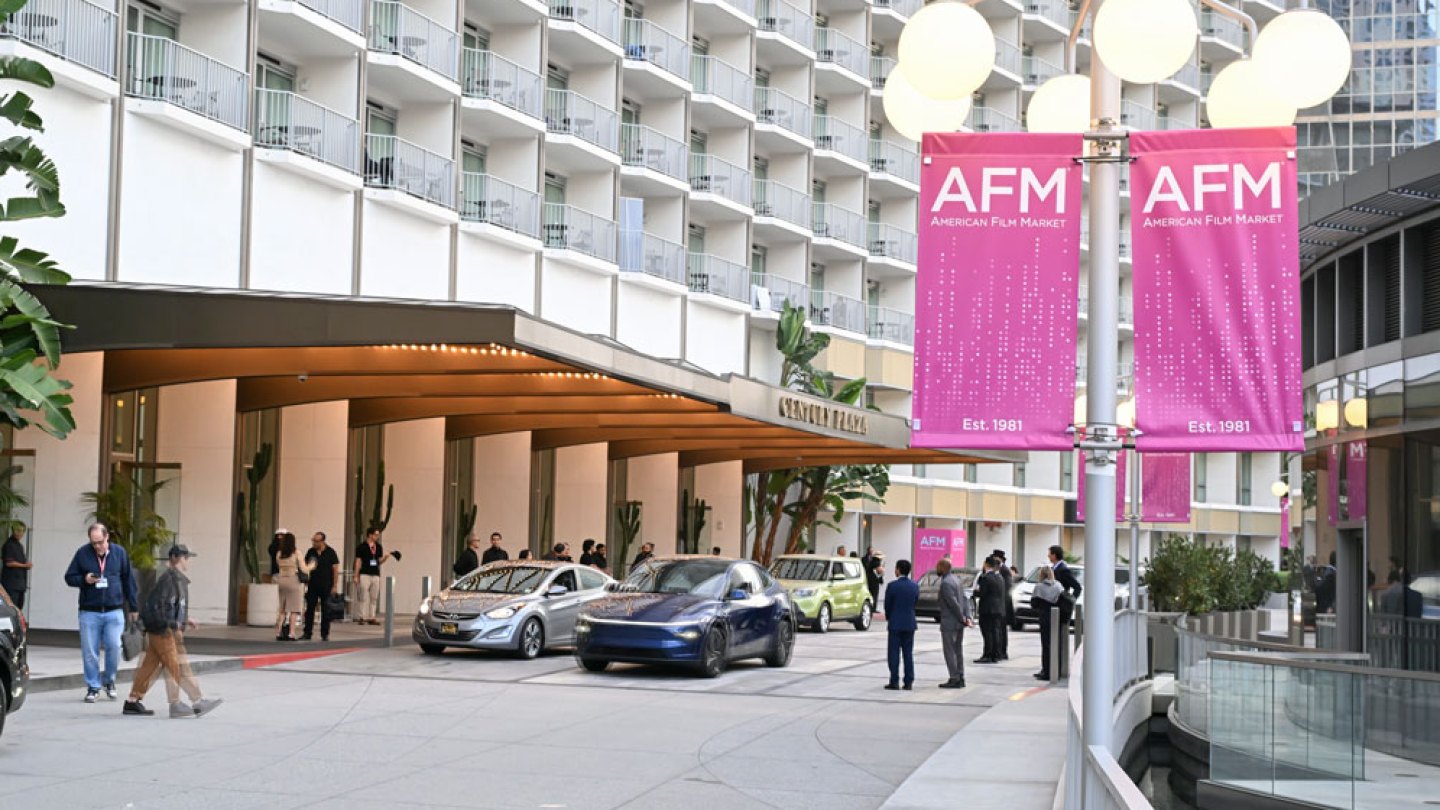
AFM Expands 2025 Conference With Inaugural Global Screen Economy Summit
The American Film Market is gearing up for its biggest and most forward-looking edition yet, with organizers announcing a new half-day Global Screen Economy Summit at the center of an expanded conference program. The summit, scheduled for Nov. 10 at the Fairmont Century Plaza in Los Angeles, will open with a keynote address from Jackie Brenneman, the newly installed president and CEO of the Independent Film & Television Alliance, the organization that produces AFM. A second keynote will be delivered by industry analyst Evan Shapiro, who will examine a media landscape profoundly reshaped by consolidation, artificial intelligence and the explosive growth of the creator economy.
The announcement signals a deliberate evolution for AFM, which was reborn last year after moving to Century City following decades in Santa Monica. According to IFTA, the November market will now place renewed emphasis on how content is financed, produced and consumed across every kind of screen, from theatrical multiplexes to streaming platforms to social video. With more than 45 sessions planned throughout the five-day event, the 47th edition of AFM promises to be as much a think tank as a deal-making bazaar.
The Global Screen Economy Summit itself is designed to confront the structural changes that have upended the independent film business. Consolidation among studios and streamers has concentrated power in fewer hands, while artificial intelligence tools are already reshaping production pipelines, marketing strategies and rights management. At the same time, creators who once aspired to traditional filmmaking careers are building global audiences independently, forcing established players to rethink how stories are discovered, financed and monetized. Shapiro, who has become one of the most quoted voices in media analytics, will use his keynote to frame these shifts within the broader economics of attention, subscription fatigue and audience fragmentation.
Brenneman, who took over leadership of IFTA earlier this year, framed the expanded program as a response to an industry in constant motion. In a statement announcing the summit, she said: “From how stories are discovered and what gets made to how content reaches audiences and the renewed excitement around the theatrical experience, nearly every part of our business is being reimagined. We’re expanding AFM to bring new voices and perspectives into the conversation alongside the industry leaders and innovators driving this change. This complements the tremendous business and dealmaking activity at the heart of the Market while creating more opportunities to connect, exchange ideas and discover new opportunities together.”
In addition to the keynotes, the AFM conference program will feature informal one-on-one conversations with Amy Baer, president of film and television at Artists Equity, and Stuart Ford, chairman and CEO of AGC Studios. Baer, a longtime independent film executive, now helps oversee production and television for Artists Equity, the company founded by Ben Affleck and Matt Damon to give filmmakers a greater share of profits. Ford, meanwhile, built AGC Studios into a major independent financier and producer, with a slate spanning star-driven features, genre titles and television series. Their presence underscores AFM’s continued relevance as a hub for high-level dealmaking, even as the market expands its intellectual agenda.
One session that is likely to draw significant attention will focus on the proposed federal production incentive aimed at keeping Hollywood film production in the United States. With runaway production a persistent concern — and with international jurisdictions such as the United Kingdom, Canada, Australia and various European countries offering aggressive tax credits — the panel will examine whether a nationwide U.S. incentive could level the playing field. The conversation comes at a moment when the Writers Guild of America and SAG-AFTRA have publicly supported federal measures to strengthen domestic production, and when several state legislatures have revised their own incentive programs in response to budget pressures.
Another highlight will be a panel titled “The New Studio System,” featuring executives from Angel Studios, Popular Demand Studios and Wesley Wang Media. The session will explore how technology and audience engagement are enabling new models of studio-like financing and distribution outside the traditional Hollywood system. Angel Studios, for example, has become known for crowdfunded and faith-based hits such as “Sound of Freedom,” which defied box office expectations in 2023. Popular Demand Studios and Wesley Wang Media represent similarly nontraditional approaches, leveraging data, direct-to-consumer relationships and niche communities to bring projects to life.
AFM organizers have also programmed panels on new film financing strategies and a session called “The New Math of Independent Film,” with speakers from Cold Iron Pictures, Wrapbook, Ashland Hill Media Finance and Legion M. That panel is expected to dig into the realities of today’s independent film economy: rising production costs, the decline of traditional presales, the growing importance of gap financing, tax incentives and equity crowdfunding, and the need for filmmakers to assemble layered, increasingly complex capital stacks. Quietly, the ways in which independent films are funded have shifted dramatically over the past decade. Where once a producer might rely on a single international sales company to pre-sell distribution rights across multiple territories, now the calculus often involves a patchwork of soft money, private equity, debt facilities, grants, streaming deals and direct fan investment.
The market will also address how audiences find and engage with content in an era of endless choice. One panel will examine the “new IP value chain,” looking at how storytellers are creating franchises and intellectual property across multiple platforms rather than reserving their most ambitious ideas for the big screen. Another, titled “New Rules of Discovery & Audience Building,” will explore the algorithmic, social-first reality that independent filmmakers now face when trying to break through the noise. A third will spotlight the resurgent horror market, with speakers from Project X, Cineverse and Spooky Pictures. Horror has long been the most reliable genre for independent financiers, and the panel will likely examine how recent theatrical successes — including films produced on modest budgets that went on to earn hundreds of millions worldwide — have made the genre even more attractive to investors.
Beyond the main conference tracks, AFM House will feature sessions covering topics as varied as alternative content for cinemas — anime, concerts, faith-based programming and other non-traditional theatrical events — and the opportunities and threats posed by artificial intelligence. The alternative content conversation reflects a growing recognition that cinemas need more than blockbuster movies to fill seats during the week. Live concerts, anime screenings, theatrical specials and religious events have become a meaningful revenue stream for exhibitors, and independent distributors are increasingly entering that space. The AI session, meanwhile, will almost certainly engage some of the most contentious issues in the industry: the ethical use of generative tools, the ownership of training data, the impact on below-the-line jobs, and the potential for AI to lower production costs for independent filmmakers.
The AFM conference expansion arrives at a critical moment for the independent film sector. The theatrical marketplace has shown signs of recovery after years of pandemic disruption, with organic breakout hits such as “Everything Everywhere All at Once,” “Sound of Freedom” and “Terrifier 3” reminding studios that audiences still crave original stories — albeit often with a hook, a niche community or a marketing angle that feels fresh. Meanwhile, the streaming wars have cooled, leading to consolidation, layoffs and a renewed focus on profitability over subscriber growth. That shift has created both challenges and openings for independent suppliers. On one hand, streamers are commissioning fewer original movies and television series. On the other, the demand for library content and the rise of ad-supported tiers have created new buyers for completed films that might previously have been overlooked.
For IFTA and AFM, the move to Century City was a statement of intent. The Fairmont Century Plaza, with its modern amenities and proximity to major studios and talent agencies, offers a more contemporary setting than the market’s former home along the Santa Monica beachfront. Organizers have said the venue supports a more curated, efficient experience for delegates, while the expanded conference program adds intellectual depth to the event’s core mission of facilitating deals.
With the inaugural Global Screen Economy Summit, AFM is positioning itself not merely as a marketplace but as the preeminent gathering for the independent film industry’s most consequential conversations. Attendees can expect not just meetings in hotel suites and screenings in nearby theaters, but also a rigorous public dialogue about the future of storytelling, the economics of independent production and the new rules of audience engagement. The lineup — bringing together executives from established companies like AGC and Artists Equity, emerging players like Angel Studios and Legion M, and analysts who track the broader media landscape — suggests an industry that is adapting to change while remaining committed to the fundamental value of cinema.
As Brenneman suggested, nearly every part of the business is being reimagined. AFM 2025 aims to be the place where that reimagining is discussed openly, in the company of the people who are actually doing it. The 47th American Film Market runs November 10 through 15, and the expanded program is set to make it the most intellectually ambitious edition in recent memory.