Apple Introduces $49.99 “Intelligence Usage Packs” in Logic Pro, Marking a New Era of Paid AI Access
Apple has quietly expanded its Apple Intelligence monetization strategy with a notable new addition: users of Logic Pro can now purchase additional AI usage directly from within the app. The move, first spotted by 9to5Mac, introduces a one-time “Buy More Usage” option priced at $49.99. The new in-app purchase is aimed at users who regularly hit the usage caps imposed on certain cloud-based Apple Intelligence features.
The announcement comes on the heels of a support article Apple published in early September, in which the company outlined usage limits for select Apple Intelligence tools. Those limits apply to features that depend on remote AI computation, rather than on-device processing. In particular, Apple has partnered with external providers such as OpenAI and Google Gemini to power some of the more advanced conversational and generative capabilities. While on-device models offer privacy and speed, cloud-hosted models require significant infrastructure and ongoing operational costs—costs that Apple appears eager to recoup through a new tier of paid access.
Logic Pro Leads the Way
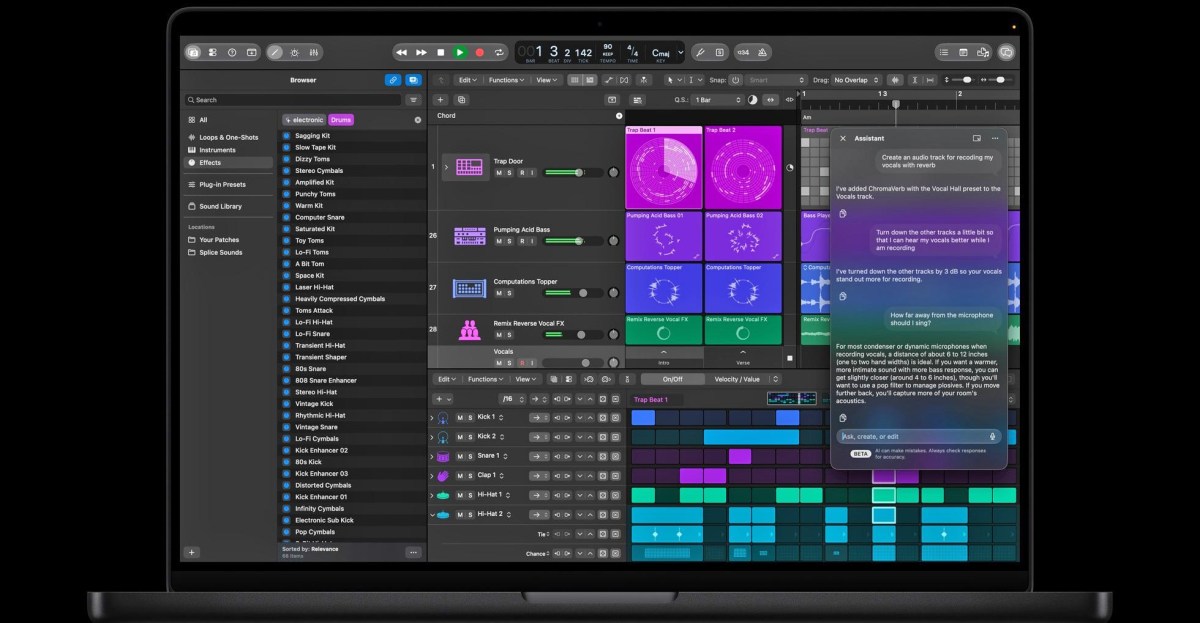
Logic Pro, Apple’s professional digital audio workstation, is the first application to offer the new Intelligence Usage Packs. The app has recently gained a built-in AI assistant designed to streamline music production workflows. Musicians and producers can use the assistant to “start a new song, set up a vocal track from a single prompt, or refine an active project.” These tasks, while ostensibly simple, can require complex models to parse user requests, analyze audio, and generate musically coherent suggestions.
For users who find themselves running out of access to these premium AI features, Apple has added a dedicated purchase flow in the app. The option appears under the main menu, in the section labeled “Intelligence Features > Show Usage.” From there, users can view their current usage status and, if necessary, buy an Intelligence Usage Pack for $49.99. This one-time purchase grants a set amount of additional usage, although Apple has not publicly disclosed exactly how many interactions or queries are included in each pack.
Members of the music production community have responded with a mix of curiosity and concern. For some, the pay-per-use model is a reasonable way to manage server costs tied to third-party AI models. Others worry that it signals a broader trend of nickel-and-diming users who have already invested in Apple’s premium hardware and software ecosystem. Logic Pro itself is not a cheap application; it typically costs $199.99, and the addition of a $49.99 usage pack has raised questions about whether Apple is moving toward a metered subscription-like model for AI features.
Understanding Usage Limits and Cloud-Based AI
Apple’s decision to introduce usage limits is rooted in the technical realities of cloud-hosted AI. Apple has long marketed its on-device AI capabilities as a privacy differentiator. Many features, such as notification summaries, photo clean-up, and text rewriting, run entirely on the device, using Apple’s own smaller language models. However, more complex tasks—particularly those requiring deep knowledge, real-time information, or broad creative generation—often require larger models hosted on remote servers.
To power these advanced tools, Apple has formed partnerships with OpenAI and Google Gemini. These third-party models are accessed through Apple’s servers but are developed and operated by external companies. The arrangement gives Apple access to cutting-edge AI capabilities without having to train and maintain enormous frontier models in-house. But it also introduces variable operational costs. Every request sent to a cloud model consumes compute resources, and the cost scales with the complexity of the query and the length of the response. This is why Apple’s support documentation notes that, in Logic Pro, usage limits are “impacted by the complexity of conversations you have with the assistant.” A short request like “add a drum track” may consume far less “usage” than a detailed back-and-forth where the user asks for multiple revisions, tonal adjustments, and new instrument suggestions.
The usage caps are not unique to Logic Pro. They apply to certain Apple Intelligence features across compatible devices and apps. The early September support article was intended to set expectations, but it was not until now that users have seen a direct, in-app mechanism for buying more capacity.
Strict Account Tying and Expiration Policies
One of the most important details to emerge from the rollout is how Apple intends to administer the new Usage Packs. According to Apple’s support website, the packs can only be used by the Apple Account that purchased them. There is no support for Family Sharing. This means that a household with multiple family members who each use Logic Pro would need to purchase separate packs for each Apple Account if all of them want to have additional AI access.
Additionally, while unused usage will roll over from month to month, it will not accumulate indefinitely. Any unused portion of a pack will expire 12 months after the date of purchase. This policy mirrors some elements of data rollover plans offered by mobile carriers, giving users a degree of flexibility while ensuring that the purchased usage is eventually consumed. It also creates a sense of urgency: users who buy a pack but do not use it regularly may lose their remaining balance after a year. For occasional Logic Pro users, the 12-month expiration could reduce the value of the one-time purchase. For heavy users, however, the ability to roll over unused usage from one month to the next may be a useful feature, particularly if their workload is inconsistent.
Apple’s decision to exclude Family Sharing stands in contrast to its approach with other services, such as iCloud+, Apple Music, and Apple Arcade, all of which support family plans. The restriction suggests that Apple views AI usage packs as highly personalized consumption—tied not just to an account, but to an individual’s interaction history and usage patterns. It also makes it harder for users to pool resources, which could encourage more purchases over time.
A Broader Rollout Is Expected
Although the Intelligence Usage Pack is currently only available in Logic Pro, Apple is widely expected to extend the option to other applications in the coming weeks. According to reporting, the purchase mechanism could be added to the broader suite of Apple Creator Studio apps this month. That includes prominent creative tools such as Pixelmator Pro, Final Cut Pro, and Motion, as well as productivity applications like Pages, Keynote, and Numbers.
These apps have been receiving new AI-powered functionality as part of Apple’s broader push to integrate generative capabilities across its ecosystem. Pages, Keynote, and Numbers, for example, are already gaining access to Apple’s AI chatbot, allowing users to draft text, generate slide content, or summarize spreadsheet data using conversational prompts. Final Cut Pro and Motion are expected to incorporate AI-assisted editing, scene analysis, and motion graphics generation. Pixelmator Pro—which Apple acquired last year—will likely see deeper integration with Apple Intelligence, including advanced image editing commands and generative art tools.
Given that all these applications will rely on cloud-based models for at least some of their AI features, it is reasonable to expect the same usage limits and purchase options to follow. Users of Final Cut Pro, for instance, might encounter caps after a long editing session filled with complex queries about transitions, color grading, or sound design. Similarly, a keynote presenter building a deck with AI-generated visuals could burn through usage much faster than someone using the same features for a few minutes per week.
The fact that Apple is rolling the packs out in phases suggests that it is still calibrating the system. The company may be monitoring how Logic Pro users interact with the purchase mechanism and adjusting pricing or usage limits before expanding to other apps. It is also possible that Apple will introduce different pack sizes or pricing tiers for different applications, depending on the computational costs associated with each feature set.
What This Means for Apple Users
The introduction of paid AI usage packs marks a significant shift in Apple’s product philosophy. Historically, Apple has bundled software features into its operating systems and applications with little or no additional cost. Users purchase a Mac, iPhone, or iPad, and they receive the full suite of built-in applications and system features. Over time, Apple has added paid subscription services like iCloud+, Apple Music, and Apple TV+, but core application functionality has generally remained a one-time purchase or a free preinstalled tool.
With the arrival of Intelligence Usage Packs, Apple is treating AI as a premium, metered resource. This is a pragmatic recognition that frontier-scale AI models are expensive to run, and that the current subscription-plus-hardware revenue model may not be enough to sustainably cover those costs. But it also creates a more complicated relationship between users and their devices. Customers must now monitor their AI usage, understand the limits, and make purchasing decisions based on how much they use the technology.
For creative professionals who rely on Logic Pro, Final Cut Pro, or Pixelmator Pro for their daily work, the added cost could become a recurring expense. A user who spends hours each day interacting with an AI assistant inside Logic Pro may need multiple packs per year, effectively turning a one-time software purchase into an ongoing operating cost. Some may find this acceptable, especially if the AI assistant dramatically improves their productivity. Others may balk at the additional expense, particularly when competitors like Adobe or Microsoft are bundling AI features into their existing subscriptions at no extra charge.
There are also broader privacy implications to consider. Users who purchase usage packs will be sending more of their creative work and conversational inputs to cloud servers. Even though Apple has promised robust privacy protections—including encryption and minimal data retention—some users may be uncomfortable relying on cloud-based AI models for sensitive musical compositions, video projects, or work documents. The local-first approach that Apple once championed is beginning to give way to a more cloud-dependent ecosystem, despite the company’s assurances to the contrary.
Looking Ahead
The launch of the $49.99 Intelligence Usage Pack in Logic Pro is likely just the beginning. As Apple continues to integrate AI into every corner of its software lineup, the line between included features and paid extras will become increasingly blurred. The company is experimenting with a model that could eventually extend beyond creative and productivity apps. What if Siri-related AI features, Xcode coding assistants, or even Health app summaries one day require additional usage packs? The precedent set by this Logic Pro rollout suggests that nothing is off the table.
For now, users are left with a simple but important choice. Those who use Apple’s AI assistant in Logic Pro heavily will need to decide whether the $49.99 pack is worth the convenience. Those who use it occasionally may still be able to stay within the free limits, as long as they keep their conversations short and avoid overly complex requests. And those who are concerned about the emerging pay-as-you-go model may reconsider their reliance on Apple’s cloud-based AI features altogether.
Ultimately, Apple’s move signals a new era in consumer AI. The era of unlimited, free AI assistants baked into every app is beginning to fade. In its place, a more commercial, consumption-based model is emerging—one where the power of artificial intelligence, like storage space or cellular data, is measured, metered, and sold to those who want more. Whether that model proves sustainable, or whether it alienates a loyal customer base, remains to be seen. But one thing is clear: from now on, when it comes to AI usage, Apple wants you to pay attention to the meter.