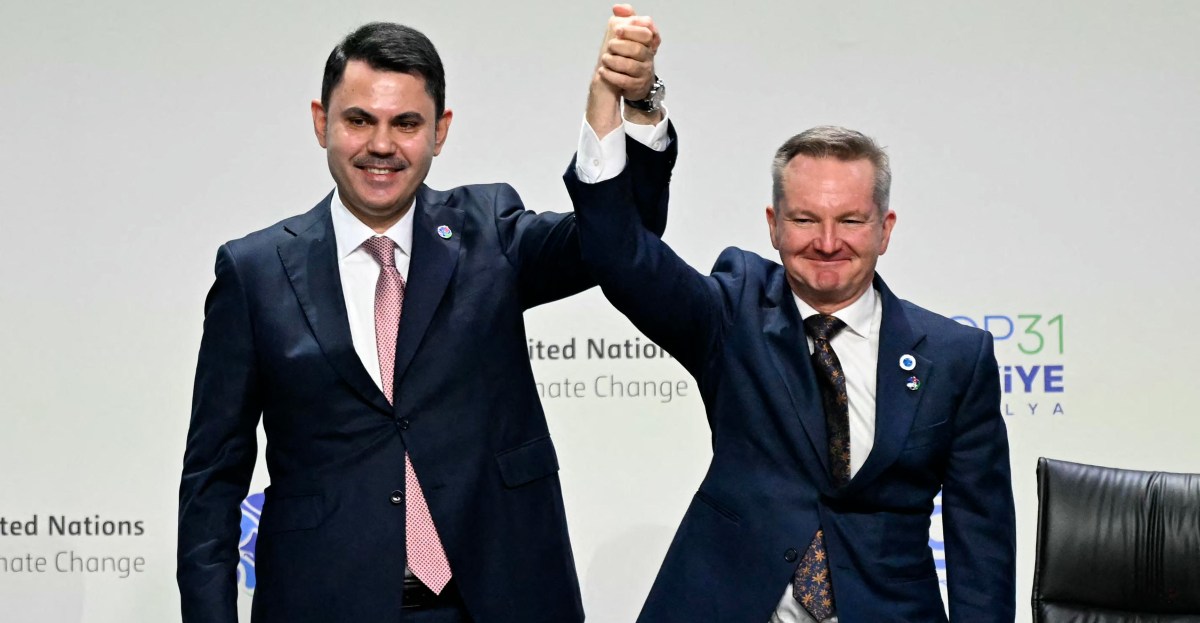
Turkey and Australia Forge Historic Joint Presidency of COP31 as Leaders Raise Hands in Unity
ANTALYA, Turkey — In a striking moment of cross-continental cooperation, Turkey’s Minister of Environment, Urbanisation and Climate Change, Murat Kurum, and Australia’s Minister for Climate Change and Energy, Chris Bowen, raised their hands together on Monday at the opening of the COP31 United Nations Climate Change Conference, formally declaring the first joint presidency in the history of the UN climate talks.
The gesture, captured during the summit’s opening session in the Mediterranean resort city of Antalya, marked the culmination of months of intense diplomatic negotiations between two countries that had once been rival candidates to host this year’s flagship climate gathering. With the two ministers standing side by side in front of hundreds of national delegates, the raised hands signalled not only a ceremonial handshake but an operational partnership meant to steer one of the most consequential climate negotiations of the decade.
“This is not just a handshake between two ministers,” Kurum told delegates as applause rippled through the cavernous conference hall. “It is a commitment between two continents, two nations, and the entire world to advance the climate agenda with urgency, solidarity, and justice.”
Bowen echoed the sentiment, framing the joint presidency as proof that even countries with different economies, geographies, and interests can work together when confronting a common threat. “Australia and Turkey are not natural neighbours,” he said. “But climate change does not respect borders. It does not ask whether you are a wealthy developed nation or a rapidly industrialising country. It simply demands that we respond, together, with all the tools we have.”
The co-presidency arrangement, unprecedented in the 31-year history of the Conference of the Parties, represents an attempt to bridge the long-standing divide between developed emitters and developing nations that has often paralysed global climate negotiations. Turkey, a NATO member that has positioned itself as a diplomatic bridge between Europe, the Middle East, and Central Asia, offers a vantage point that is distinct from Australia’s Pacific-oriented perspective. Together, the two countries hope to meld their influence to create a more inclusive and resilient negotiating process.
A contested hosting race gives way to collaboration
The road to Antalya was anything but smooth. For much of 2025, Turkey and Australia engaged in an intense diplomatic competition to secure the right to host COP31. Australia campaigned heavily on its existing climate partnerships with Pacific island nations, which are disproportionately threatened by rising sea levels and increasingly catastrophic weather events. Turkey argued that its geographic position at the crossroads of three continents made it a natural venue for a summit in which energy security, migration, and regional conflict would inevitably play influential roles.
Negotiations over the host country were frequently described by diplomats as deadlocked, with neither side able to secure a decisive majority among the UN’s regional groupings. But rather than permitting the deadlock to delay preparations, officials from both capitals began exploring a novel solution: sharing the presidency and co-hosting the summit. Sources close to the discussions say that the idea gained traction during intergovernmental meetings in the lead-up to COP30 in Belém, Brazil, where ministers from both delegations privately discussed the possibility of a joint arrangement.
The resulting structure is unprecedented. Instead of a single president leading the talks, Kurum and Bowen serve as co-presidents, with shared authority over the agenda, ministerial consultations, and the final negotiating texts. They will reportedly share responsibilities during the marathon final week of negotiations, when the summit’s most challenging issues — including climate finance, fossil fuel phase-down, and adaptation assistance — are likely to come to a head.
Agenda dominated by finance and fossil fuel tension
The opening session on Monday set out a packed two-week agenda. Red lines, remaining challenges, and new negotiating groups were quickly enumerated by the co-presidents, but for many delegates, the priority list remains familiar and unfinished.
The first major issue concerns the new collective quantified goal on climate finance, the successor to the pledge of US$100 billion per year that was first made over a decade ago. Developing countries have consistently pressed for hundreds of billions of dollars in annual support to fund clean-energy transitions, adapt to climate impacts, and rebuild after climate-related disasters. Negotiators in Antalya will be tasked with turning the overarching ambition of the goal into a concrete, accountable, and accessible system that reaches the most vulnerable.
Also high on the agenda is the continued operationalisation of the Loss and Damage Fund, which was formally established at COP28 in Dubai and expanded during COP30 in Belém. The fund is intended to help countries that have been severely harmed by slow-onset climate events and extreme weather catastrophes. However, significant disagreements remain over the scale of contributions from wealthier countries, the role of multilateral development banks, and the mechanisms through which affected communities can access resources without excessive bureaucracy.
A third critical area is emissions reduction. The landmark global stocktake concluded at COP28 in the United Arab Emirates gave the world what many considered a clear mandate — transition away from fossil fuels in energy systems and triple renewables capacity by 2030. Yet nearly all major countries remain off track, according to recent United Nations assessments. The summit in Antalya is viewed as a critical milestone for countries to update their national climate plans and articulate how they will accelerate the deployment of solar, wind, and battery storage, while making credible plans to phase down coal, oil, and gas.
“The science is not ambiguous. The timeline is not generous. The only question is whether we have the courage to meet the moment,” Bowen said at a press conference after the opening session. “Australia understands the enormous difficulty of decarbonisation as a major energy exporter. But we also understand that the long-term prosperity of our nation and every nation depends on a stable climate.”
Turkey’s dual role as a bridge and a spokesperson for the vulnerable
For Turkey, hosting the summit is a moment of considerable diplomatic significance. The country has in recent years experienced the full harshness of a warming world. Catastrophic wildfires have consumed hectares of the country’s pine forests, scorching coastal towns and underlining the urgency of adaptation investments. Drought has affected parts of the Anatolian heartland, while Turkish scientists warn that the country’s Mediterranean coastline, where the summit is being held, will experience rising sea levels and more frequent extreme heat events in the coming decades.
At the same time, Turkey retains a distinctive geopolitical position in the climate debate. It has historically argued that its own development status and its growing industrial sector merit special consideration in climate agreements — a position that has occasionally placed it at odds with Western governments. By taking on a leadership role, Turkey is seeking to present itself as both a solidly climate-conscious nation and an advocate for countries in the developing world that are making the difficult transition to clean energy while still trying to improve living standards for their citizens.
“We are a nation that understands that development and climate action are not opposite goals. They are inseparable,” Kurum explained. “We have invested heavily in wind and solar capacity. We have launched a Zero Waste movement that has been recognised across the world. And we are actively working with regional partners to promote climate resilience in the Balkans, the Middle East, North Africa, and Central Asia.”
Kurum also pointed to the significance of holding COP31 in the Mediterranean, one of the fastest-warming regions on the planet. “The Mediterranean basin is a climate hotspot. The people of this region are already living with the impacts. When we negotiate in Antalya, we are negotiating for our own communities,” he said. “And that makes the talks not abstract, but deeply personal.”
Global reactions and the shadow of geopolitics
The joint presidency has received a cautious welcome among many climate advocacy groups, though some have expressed concern that placing two countries with large fossil fuel industries at the helm of climate talks could blunt the ambition that previous summits have generated. Australia remains one of the world’s largest exporters of coal and liquefied natural gas, and although its domestic emissions have begun to trend downward, international environmental groups have repeatedly challenged the country to align its export policies with the Paris Agreement. Similarly, Turkey’s greenhouse gas emissions have risen in recent years, largely driven by energy demand and industrial expansion, though its per capita emissions remain well below those of most developed countries.
During a side event on Monday, representatives from climate justice organisations maintained that the coral status quo is insufficient. “We cannot be satisfied by the architecture of the talks. We will only be satisfied by the outcomes,” said one spokesperson for a coalition of small island state advocacy groups. “The people of the world cannot wait another decade for the promises to be fulfilled. The world is watching, and the world is running out of time.”
Other observers noted that the backdrop to this year’s talks is particularly fraught. Global energy markets remain volatile, the ongoing conflict in the Middle East continues to shape geopolitics, and diplomatic tensions between major powers continue to create difficulties in securing unanimous agreements. The co-presidency arrangement, however, has been interpreted by many delegates as a practical response to this geopolitical fragmentation. If countries cannot agree even on who should host the talks, they can at least agree on a format that reflects the need for dialogue and compromise.
The days ahead
The summit is expected to continue for two weeks, with high-level ministerial segments running from mid-November until the final plenary sessions. There is widespread speculation as to whether the co-presidents will succeed in delivering a comprehensive and substantive outcome in Antalya. The agenda includes a series of ministerial dialogues on adaptation, climate finance, and the energy transition, as well as the traditional science events and civil society forums that have become a central part of every COP.
Both leaders have stressed that their co-presidency is intended to be practical, rather than symbolic. They have jointly pledged to prevent the talks from collapsing under the weight of procedural disputes and to preserve space for the kind of high-stakes diplomacy on which the UN process depends.
“We are not naive. We know that these negotiations will be difficult,” Kurum said. “But we also know that the world is tired of stalemate. The world is tired of declarations without action. And the world is looking to us, in this beautiful city, to turn a corner.”
Bowen added that the image of the two ministers raising their hands together will be remembered not as a spectacle, but as a starting point. “When we raise our hands, we mean the world to see that collaboration is possible,” he said. “It is possible between Australia and Turkey. It is possible between regions that have different interests. And it is possible between every country that is willing to act.”
As delegates filed out of the opening session into the warm Mediterranean sunlight, there was a sense that the coming days would be decisive for the global climate movement. For now, the world could take note of an unusual partnership — one forged not in a climate emergency, but in an equally pressing reality: that no single nation can solve the crisis alone, and that even rival hosts can become partners when the stakes are high enough.