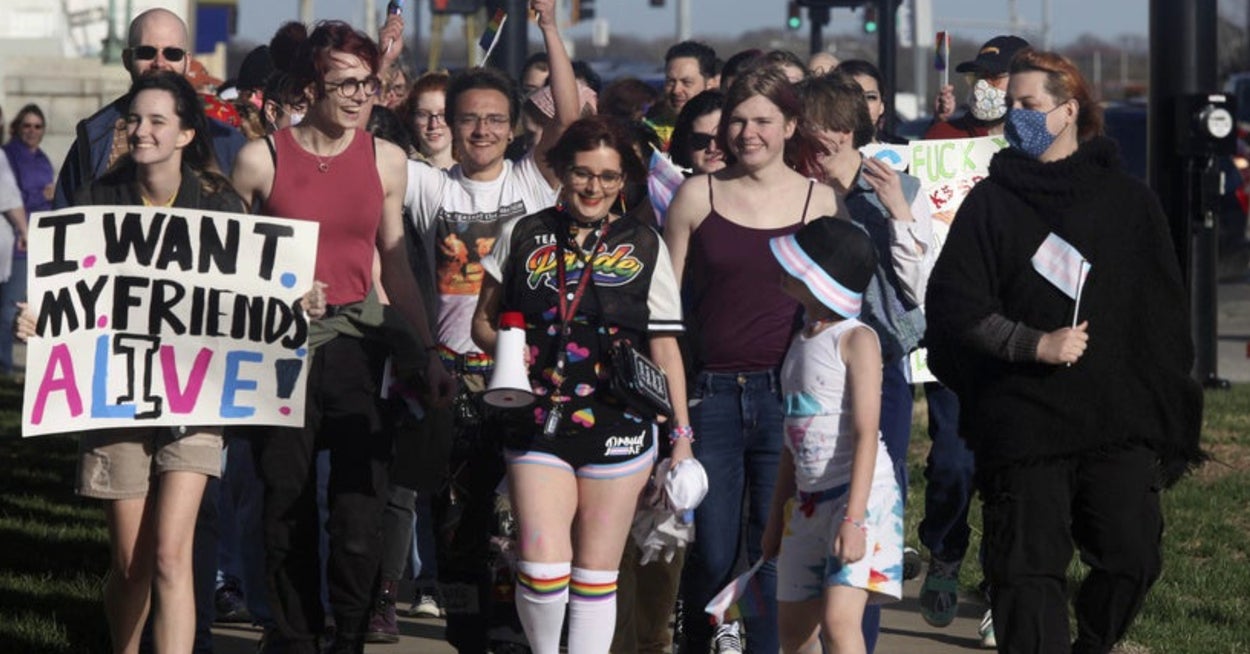
Kansas Lawmakers Pass Sweeping Anti-Trans Legislation as GOP Supermajority Prepares to Override Veto
Kansas is set to become the latest flashpoint in the nationwide fight over transgender rights, with Republican lawmakers advancing a sports ban and a broader package of restrictions that would affect transgender residents’ access to public restrooms, locker rooms, and even the gender markers on their driver’s licenses.
The sports measure, which would prevent transgender girls from competing on girls’ school sports teams, is scheduled to go into effect July 1 unless a judge blocks it. Proponents say it is necessary to protect fair competition among cisgender girls and women. But the actual number of transgender athletes affected is extraordinarily small. According to the Kansas State High School Activities Association, only three transgender girls are currently competing in sports at the high school level in the state. That figure is a tiny fraction of the overall number of high school athletes in Kansas, and it has led critics to question why lawmakers are devoting so much attention to the issue.
State Rep. Wasinger, when asked by BuzzFeed News whether the bill could lead to genital inspections of athletes, did not answer directly. Instead, Wasinger issued a statement saying: “Sports physicals are done for every athlete participating in schools sports. Every child in Kansas must provide a birth certificate to attend school in Kansas. Both should be enough for any student.”
Critics of such policies have argued that birth certificates and sports physicals are not reliable proxies for determining a person’s gender, and that the demand for verification can create humiliating barriers for young people. Wasinger’s response did not address the specific concerns about invasive checks, which opponents of similar bills have raised in other states.
The sports ban is only one piece of a much larger legislative push in Kansas. On Tuesday, lawmakers also passed SB 180, a bill that Republicans have branded the “Women’s Bill of Rights.” The bill would ban transgender people from using public restrooms and locker rooms that align with their gender identity. It would also prohibit transgender people from changing their name and gender markers on driver’s licenses. The legislation defines sex in binary terms as “either male or female, at birth,” a definition that LGBTQ advocates say would lead to the legal erasure of transgender, gender-nonconforming, and intersex people.
The effect of such a definition, opponents warn, would be to codify into state law a narrow and medically inaccurate understanding of sex. Intersex people, who are born with reproductive or sexual anatomy that does not fit typical definitions of male or female, would be particularly vulnerable. Transgender people, whose gender identity differs from the sex they were assigned at birth, would also be denied legal recognition in a wide range of settings. If the state does not legally recognize a person’s gender identity, that person could be excluded from bathrooms, locker rooms, and other spaces, and could face barriers in employment, housing, and public accommodations.
Kansas’s actions are not happening in a vacuum. The state is part of a wave of anti-trans legislation moving through Republican-controlled statehouses across the country. The Kansas measures are notable because they bundle multiple restrictions together and use broad language that extends beyond a single issue. Rather than addressing one policy area, the bills touch on education, public facilities, identity documents, and the legal definition of sex itself.
Last week, Kentucky’s Republican-controlled legislature overrode the veto of Democratic Gov. Andy Beshear to pass an omnibus anti-trans bill. That law banned gender-affirming care for transgender youth, barred transgender students from using bathrooms that align with their gender identity, and gave school officials the right to refuse to use students’ requested pronouns. Like the Kansas measures, the Kentucky law was driven through by a Republican supermajority that had the votes to override the governor.
In Kansas, Republicans have more than a two-thirds majority in the legislature, which means they have enough votes to overturn a veto from Democratic Gov. Laura Kelly. That dynamic has made the state a testing ground for some of the most far-reaching anti-trans policies in the country. Even if Kelly vetoes the sports ban or SB 180, the Republican supermajority can likely override her and make the measures law.
The sports ban has drawn particular criticism because of the tiny number of transgender athletes it would affect. Supporters argue that transgender girls may have physical advantages over cisgender girls, and that allowing them to compete in girls’ sports would be unfair. But the numbers in Kansas suggest that this is not a widespread issue in the state’s high schools. With only three transgender girls participating in high school sports, opponents say the bill is a solution in search of a problem, driven by national culture-war politics rather than local necessity.
The broader implications of the Kansas legislation are significant. If SB 180 becomes law, transgender people in Kansas could face restrictions in every public building with restrooms or locker rooms, from schools and government offices to parks and other public facilities. The prohibition on changing name and gender markers on driver’s licenses would make it more difficult for transgender people to obtain identification that reflects who they are, which in turn can affect their ability to vote, work, travel, and access healthcare.
Advocates for transgender rights have said that the Kansas legislation, along with similar bills in other states, is part of an effort to push transgender people out of public life. The definition of sex as “either male or female, at birth” is particularly troubling to advocates because it would create a legal foundation for discrimination. Once the state refuses to recognize a person’s gender identity, that person can be treated as though their identity does not exist in the eyes of the law.
The push in Kansas reflects a broader strategy among conservative lawmakers to pass multiple, overlapping restrictions in a single session. By combining sports bans, bathroom restrictions, and identification rules, they create a legal environment in which transgender people must constantly prove their identity. Supporters of the measures say they are simply protecting women and girls, but opponents see a coordinated effort to marginalize a vulnerable population.
The legal status of the Kansas measures remains uncertain. The sports ban is set to take effect July 1 unless a judge blocks it. Legal challenges are likely, and civil rights organizations have already been fighting similar laws in other states. Courts have issued mixed rulings on transgender sports bans, with some judges allowing them to take effect and others blocking them.
For now, Kansas is moving forward with one of the most aggressive anti-trans legislative agendas in the country. The state’s Republican leaders have made clear that they intend to use their supermajority power to push the measures through, regardless of the governor’s position. And with only three transgender girls playing high school sports in the state, the debate is less about the reality of Kansas athletics than about the future of transgender rights in the United States.
The coming weeks will determine whether the sports ban takes effect as scheduled and whether SB 180 can withstand a potential veto and legal review. What is already clear is that Kansas has become a central battleground in the fight over how transgender people are treated in schools, in public spaces, and in the law itself.