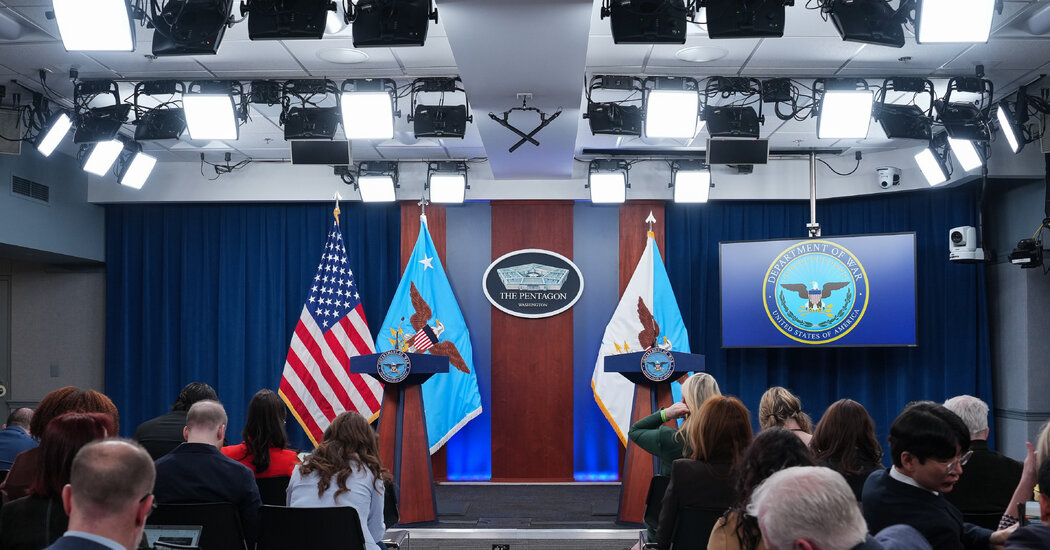
On Monday, The New York Times filed a lawsuit against the Department of Defense, alleging that the department is infringing upon the First Amendment rights of journalists by mandating they always be accompanied by an official escort when inside the Pentagon. This lawsuit represents the second time the newspaper has sought legal recourse over what it perceives as unjust restrictions imposed by the Trump administration on journalists covering the military complex.
The newly filed lawsuit argues that the Pentagon’s escort policy is not in line with the Constitution as it places undue burdens on reporters. According to a policy adopted by the department in March, journalists must first make a call or send an email to request an appointment, wait for a response, then when they arrive, they are required to be escorted at all times, ask their questions, and then leave the building. The New York Times is seeking a court ruling to compel the Pentagon to lift these restrictions.
Sean Parnell, a spokesperson for the Pentagon, defended the department, stating that the lawsuit was a calculated move by The Times in an attempt to gain access to classified information. Parnell further argued that the department’s policy is both lawful and designed with precision to safeguard national security information from being unlawfully disclosed.
The case put forth by The Times forms the latest development in an ongoing legal confrontation over the Pentagon’s increasing attempts to limit the freedoms of journalists who cover the military complex. Defense Secretary Pete Hegseth has been consistently imposing limitations on journalists’ access within the Pentagon, including the requirement for escorts in certain areas of the building. In October, the department introduced a comprehensive set of restrictions, including the ability to label journalists as potential “security risks” and subsequently revoke their press passes.
In December, The Times launched a lawsuit against the Pentagon, claiming that these restrictions were a violation of the First and Fifth Amendment rights of its journalists. In response to this lawsuit, Judge Paul Friedman of the U.S. District Court ruled in favor of The Times in March, declaring significant portions of the October policy invalid. Following this decision, the Pentagon issued an “interim” policy which included mandatory escorts for all journalists, among other changes. The department also shut down the long-established workspace for journalists in the Pentagon.
After analyzing the interim policy, Judge Friedman also rejected its core elements. However, the Pentagon requested an appeals court to permit the escort requirement to stay in effect while the department appealed both rulings made by the judge. In April, a divided three-judge panel from the U.S. Court of Appeals for the District of Columbia Circuit allowed the escort requirement to remain active during the appeal process.
In its most recent lawsuit, The Times claims that the interim policy is “patently retaliatory” and that the escort requirement renders the press passes of Times journalists “essentially worthless”. The purpose of this new lawsuit, as stated in the complaint, is to challenge the interim policy “on its own terms”. The Times argues that the policy’s restrictive measures are not only unnecessary but also serve to hinder the free press from performing its essential role in a democratic society.
The New York Times’ legal actions against the Pentagon reflect the broader tensions between the Trump administration and the media. The administration has often criticized major media outlets, including The Times, for their reporting on its activities. These lawsuits and the resulting court decisions will have significant implications for the freedom of the press and the ability of journalists to report on the activities of the U.S. government, particularly in areas related to national security.
It remains to be seen how this legal battle will play out and what impact it will have on the relationship between the media and the government. The case raises important questions about the extent to which the government can restrict the activities of journalists in the name of national security, and about how these restrictions affect the public’s right to be informed about the activities of their government. The decisions made in this case will likely set a precedent for future interactions between the media and the U.S. government, and for the protection of press freedom in a democracy.