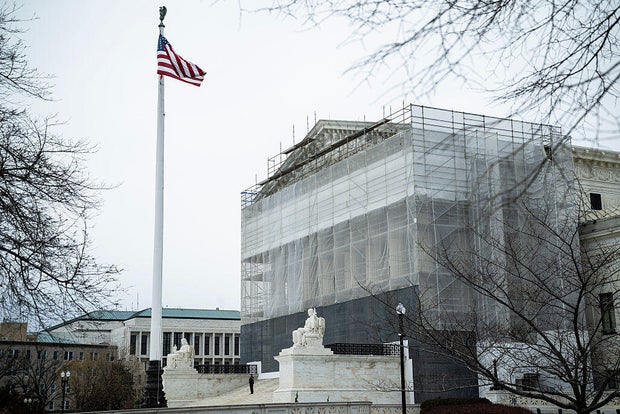
In a significant case in Washington on a breezy Monday afternoon, the United States Supreme Court delved into a complex legal battle centered around presidential powers and the independence of federal regulatory agencies. This case, known as Trump v. Slaughter, opened a discussion that could reshape the landscape of American governance.
At the heart of the contention was President Trump’s endeavor to dismiss Rebecca Kelly Slaughter, a commissioner at the Federal Trade Commission (FTC). The challenge drew on a precedent set by the 1935 Supreme Court ruling in Humphrey’s Executor v. United States, a decision that restricted the president’s ability to remove FTC members to instances of “inefficiency, neglect of duty, or malfeasance in office.”
Representing a pivotal moment in the tug-of-war between presidential power and legislative safeguards against undue influence, the Trump administration argued that these restrictions were unconstitutional under the separation of powers doctrine. The administration posited that the FTC, a body wielding executive power, should be squarely under the control of the president, permitting dismissal of its members for any reason.
Contrastingly, the defense, represented by attorneys for Slaughter, argued that these limitations were well within the legislative powers of Congress, structured to ensure that independent agencies like the FTC could operate without excessive political interference. They feared that dismantling these protections could destabilize the independence of not just the FTC, but other similar entities critical to the federal framework, such as the U.S. Tax Court and various civil services.
Notably, the oral arguments echoed across the grand hall of the Supreme Court building, a historic structure that stood as a testament to the gravitas of the topics it has hosted. Solicitor General D. John Sauer spearheaded the administration’s argument, urging the justices to overturn the Humphrey’s Executor decision, labeling it as an outdated impediment to clear constitutional mandates and a generator of ongoing legal confusion.
The bench responded with varied inclinations. The liberal justices—Sonia Sotomayor, Elena Kagan, and Ketanji Brown Jackson—expressed their apprehensions about revoking the long-standing protections. Justice Sotomayor vocalized concerns about potential chaos across government operations, indicating that such a shift could lead to a broad dismantling of institutional stability across the federal corpus.
Justice Kagan and Justice Jackson further scrutinized the potential implications of overturning historical precedents, pondering about the eventual reach of presidential control and its impact on legislative and judicial functionalities within the government.
Conversely, the conservative justices seemed inclined toward reassessing or possibly dismissing the Humphrey’s Executor framework. Justices Brett Kavanaugh and Neil Gorsuch particularly hinted at the broader constitutional and practical issues presented by extensive delegation of power to independently run agencies.
As arguments flew back and forth, the attorney representing Commissioner Slaughter, Amit Agarwal, highlighted the historical context and congressional intent behind the protective statutes. He emphasized the tradition stemming from as far back as the 18th century, presenting a narrative of continuity and stability fostered by these legislative measures.
The discussions also extended to hypotheticals which tested the limits of congressional power over executive appointments, a thematic exploration that Justices Clarence Thomas and Samuel Alito ventured into, probing the extents and bounds of the arguments presented.
The significance of this case wasn’t lost on the broader legal and political communities. Over the past few years, especially with the resurgence of Trump in the White House for a second term, there has been a marked shift toward challenging established norms around presidential powers and agency independence. This case followed a trajectory of legal precedents being questioned, with recent examples including challenges to the Consumer Financial Protection Bureau and the Federal Housing Finance Agency, among others.
In a broader scope, the outcome of this case could potentially recalibrate the balance of power across the branches of the U.S. Government, influencing how laws are implemented and by whom. The implications stretch far beyond the FTC, touching on every corner of federal regulatory frameworks and defining how secured or vulnerable these agencies are against political shifts.
As the debate raged on in the Supreme Court, the politico-legal spheres watched closely, understanding that the ramifications of this decision would resonate through the annals of American governmental structure, potentially redefining the scope of presidential authority, congressional oversight, and the independence of the judiciary in the intricate dance of American democracy.
This case serves as yet another landmark in the ongoing discourse about the distribution and exercise of power within the federal system, encapsulating key issues about governance, accountability, and the interplay between different branches of government in the United States.