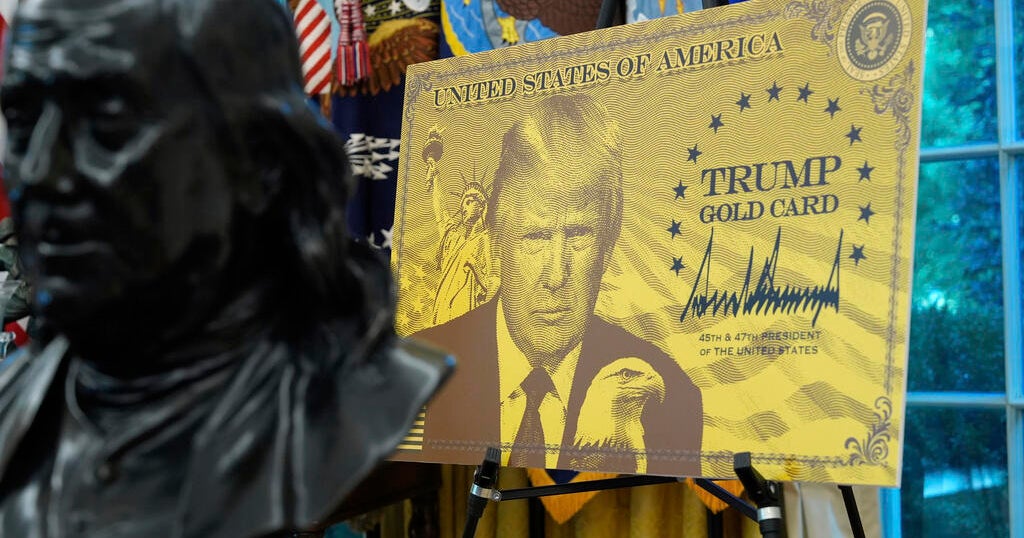
On a recent Friday, President Donald Trump enacted a significant shift in U.S. visa policy by signing an executive order introducing a new “Gold Card” visa program. This ambitious initiative allows individuals to fast-track their path to becoming permanent U.S. residents by making a substantial financial contribution to the country. The announcement, which has sparked a mix of intrigue and controversy, stipulates that individuals who donate at least $1 million to the Commerce Department can swiftly obtain an immigrant visa. Moreover, corporations are also eligible to participate by sponsoring candidates for the Gold Card, provided they contribute a minimum of $2 million to the government.
The newly introduced website dedicated to this program, adorned with slogans like “The Trump Gold Card is Here” and “Unlock life in America,” showcases a glitzy card emblazoned with images of President Trump, the bald eagle, and the Statue of Liberty. This flamboyant presentation highlights the administration’s bold approach to immigration reform, diverging significantly from traditional avenues primarily based on family reunification, employment qualifications, or humanitarian grounds.
According to Commerce Secretary Howard Lutnick, the administration plans to issue a total of 80,000 Gold Cards. Currently, the program is still in its deployment phase but is moving forward rapidly. He detailed that following a vetting process conducted by the State Department and the Department of Homeland Security — including a $15,000 vetting fee — approved applicants will be considered lawful permanent residents. This status is commonly referred to as green card holders.
Lutnick further explained that this initiative would replace the existing EB-1 and EB-2 visa categories. These categories traditionally cater to individuals who demonstrate “exceptional ability” in their respective fields, such as business, academia, or the arts. Under the Gold Card framework, the benchmark for offering tangible value to the U.S. shifts notably towards financial contributions.
“There is an inherent value proposition to welcoming individuals who can make such significant financial contributions to our economy,” Lutnick remarked during a press briefing. He also suggested that other current visa categories might soon be suspended in favor of this new model, emphasizing a substantial pivot in U.S. immigration policy towards capital-centric qualifications.
Parallel to the Gold Card program, discussions are on the table for a more exclusive “Platinum Card.” This higher-tiered option, requiring a donation of $5 million, would allow individuals to spend up to 270 days in the U.S. without being taxed on their foreign income. However, unlike the Gold Card, it does not offer a pathway to citizenship and will require Congressional approval before it can be enacted. A waiting list has already been established online to gauge potential interest.
In another move that underscores the administration’s tough stance on immigration reform, President Trump also signed an executive order imposing an additional $100,000 fee on H-1B visas. This non-immigrant visa permits tens of thousands of individuals to reside and work in the U.S. for up to six years, and is particularly prevalent in industries such as technology where there is a high demand for specialized skills that are scarce among the U.S. workforce.
This fee represents a significant financial hurdle for potential H-1B applicants and seems aligned with broader efforts to curb the program, which some critics argue undermines U.S. wages by allowing companies to employ foreign workers at lower salaries. Despite these criticisms, proponents of the H-1B visa argue it is crucial for industries that depend on a global talent pool to fill highly specialized roles.
Responding to inquiries about how this could impact major tech companies — many of which rely heavily on H-1B visas — President Trump suggested that the increased fees would not deter these companies. Instead, he posited that they would welcome the opportunity to secure top talent, albeit at a higher price, thereby contributing more substantially to the U.S. economy.
“These measures, both the creation of the Gold and potentially Platinum Cards and the new fees for H-1B visas, represent a clear paradigm shift,” President Trump commented. “We are prioritizing substantial economic contributions and investing in maintaining a competitive edge in global industries.”
The introduction of these policies marks a pivotal moment in U.S. immigration strategy, steering away from traditional merit and relations-based criteria towards a distinctly transactional approach. This shift raises profound questions about the values and objectives that should guide the nation’s immigration system in the 21st century.